Portuguese Legion (La Legion portugaise, Legiao Portuguesa) is a Portuguese military unit composed of the Grand Army (Grande Armee). In 1807 Portuguese French Army (Armee du Portugal) under the command of General Junot (Jean-Andoche Junot) invaded Portugal. December 23, 1807 Junot took Lisbon (Lisbon) and imposed on the country indemnity to the tune of 100 million francs.
December 22, 1807 national army was disbanded by a decree of the Emperor of the Portuguese and January 16, 1808 a decree on the formation of the Portuguese Legion under the command of Lieutenant-General Almeida, Marquis d. Alorna (Pedro de Almeida, Marques de Alorna) was appeared.
The legion divisional structure included five infantry regiments (each with 6 companies for 140 people), a battalion of foot chasseurs, three regiments of mounted rangers (4 squadrons, each with two companies of 100 people), the depot battalion of infantry, a squadron of cavalry and artillery depot battery (of 9000 people), was released in April 1808 of Salamanca (Salamanca), and passing through Spain, arrived to Bayonne (Bayonne).
June 1, 1808 The Emperor took the Portuguese Legion parade, was satisfied with it and invited the officers for dinner and allowed the soldiers to share a meal with the Imperial Guard (Garde Imperiale).
Composition of the Legion in 1808:
-- General Almeida Marquis d, Alorna (Pedro de Almeida, Marques de Alorna),
-- 2nd Lieutenant-General Freyr, D.Andrade (Gomes Freyre d, Andrade).
-- Major Frey (Joao Salazar Freire), Major Mosinee de Brito (Maximiano
Mozinho de Brito), Major Galvao (Joao Antunes Galvao), Major Lobo de
Silveira, the Marquis d, Alvito (Fernando Jose Quaresma Lobo de
Silveira, Marques de Alvito ) were Aides of the Commander.
-- Major de Sa e-Benevides, Vicomte de Asseco (Antonio Maria Correia de
Sa-e-Benevides, Visconde de Asseca) were Adjutants of the 2nd Commander.
-- Marshal Pamplona Corte Real (Manuel Ignacio Martins Pamplona Corte-Real) was Chief of Staff.
-- Maj. Francine (Marino Miguel Franzini) was Deputy Chief of Staff.
-- Captain de Souza (Domingos Bernardino de Sousa), Captain Cardoso (Francisco Cardoso) were Aides Chief of Staff.
-- Major de Castro (Manuel de Castro), Captain Garsez (Jose Garcez),
Lieutenant Soarez (Jose Soares), Lieutenant Branco de Santana (Joaquim
de Santana Branco), Lieutenant Teixeira (Jose Joaquim Teixeira),
Lieutenant Rebelo (Diogo Jose Rebelo), Lieutenant Pereira (Joao Pereira)
were Staff officers.
1st Infantry Division of Marshal de Lobo Karkom (Jose de Carcome Lobo):
-- Ribeiro de Souza (Joao Ribeiro de Sousa) was Chief of Staff Brigadier.
-- Lieutenant Bandeira (Antonio Joaquim Bandeira) was Adjutant of divisional commander.
1st regiment:
-- Commander Colonel de Saldanha e-Albuquerque (Joaquim de Saldanha-e-Albuquerque),
-- staff officers, Lieutenant Colonel de Portugal e-Castro, Marquis de
Valencia (Jose de Portugal-e-Castro, Marques de Valenca) Major 1st
Battalion de Almeida (Julio de Almeida) were in the 1st Infantry
Regiment.
2st regiment:
-- Commander Colonel de Lima, the Marquis de Ponte de Lima (Jose Tomas Xavier de Lima, Marques de Ponte de Lima),
-- staff officers, Lieutenant Colonel Tavares (Joao Antonio Tavares),
-- Major 1st Battalion Moniz (Bernardino Antonio Moniz ), Major 2nd
Battalion Torres (Julio Francisco Torres) were in the 2nd Infantry
Regiment .
3st regiment:
-- Commander Colonel Frey-Feyo (Francisco Antonio Freire-Feio),
-- staff officers, Lieutenant Colonel de Sa Carneiro (Antonio Batista de
Sa Carneiro), Major of the 1st Battalion Ferreira (Baltasar Ferreira)
and Major of the 2nd Battalion Baron de Tshudi (Baron Jean de Tschudy)
were in the 3rd Infantry Regiment.
The 2nd Infantry Division of Marshal de Brito Mosinee (Joao de Brito Mozinho).
4st regiment:
Colonel de Brito Mosinee (Manuel de Brito Mozinho) was the Chief of Staff.
-- commander Colonel Botelho, Comte de San Miguel (Alvaro Jose Xavier Botelho, Sonde de São-Miguel),
-- staff officers, Lieutenant Colonel Cardoso (Jose Antonio Cardoso), Battalion Chief Martigny (Alexandre Martigny).
5th Infantry Regiment:
-- commander Colonel Ferreri (Francisco Ferreri),
--staff officers, Lieutenant Colonel de Macedo (Antonio de Macedo),
Major 1st Battalion Stewart (Francisco Stuart), captain of the 2nd
Battalion, Beninger (Alexandre Jose Beninger).
Battalion of riflemen (cacadores) of battalion chief’s Branko (Francisco Claudio Branco).
Cavalry Brigade of Field Marshal de Souza (Manuel Guilherme Frederico de Sousa).
1st Cavalry Regiment included:
commander Colonel Ferreira de Aguilar (Roberto Ferreira de Aguiar), staff officers, Lieutenant Colonel Comte de Sabugal (Conde de Sabugal), Major de Castro (Joao Benedito de Castro), Major D, Artez (d, Artaise).
2nd Cavalry Regiment included:
commander Colonel de Fonseca (Alvaro Xavier da Fonseca Coutinho-e-Povoas), staff officers, Lieutenant Colonel de Saint-Rezar (de Saint-Rezard), Major de Souza (Joao Carlos de Sousa), Major Braamkamp (Hermano Braamcamp).
3rd Cavalry Regiment included:
commander Colonel de Mendoza, Marquis de Loulé (Agostinho Domingos Jose de Mendonsa, Marquis de Loult), staff officers, Lieutenant Colonel Nobre (Joao Antonio Ramos Nobre), Major Pinto (David Pinto), Maj. Cary (Antonio Carlos Cary ),
Squadron of mounted riflemen (cacadores-a-cavalo) of the Squadron chief de Melo (Joao de Melo),
Battalion of foot chasseurs (sacadores) served on the Iberian Peninsula as a part of the Spanish Army (Armee d, Espagne) and took part in the first siege of Saragossa (Saragossa) from June15 to August13,1808 under the command of General Freire d, Andrada (Gomes Freyre d, Andrade),
1st regiment of mounted rangers Legion fought at Behe (Beja), Evora (Evora) and Lisbon (Lisbon) under the command of Colonel Agulyara (Roberto-Ignacio d, Agular),
The other parts of the Legion joined the Grand Army, infantry housed in Grenoble (Grenobles), cavalry - in the GRE (Gray),
In 1809 three battalions of Colonel Freyr-Pego (Fransisco-Antonio Freire-Pego) were formed from the Grenadier and Voltigeurs’s coys of the Legion, organized jointly with the two squadrons of mounted rangers in the 13th elite demi-brigade of General Karkom Lobo (Jose Carcome-Lobo) as a part of the 3rd Division of General Oudinot (Charles-Nicolas Oudinot) of the II-corps Marshal Lannes (Jean Lannes).
Demi-brigade took part in the Austrian campaign in 1809 and gave a taste of itself quality in the battles of Entsendorfe (Enzendorf) and Wagram (Wagram) (during the campaign, the Portuguese lost more than 400 soldiers and officers).
After the reorganization of May 2, 1811 the Legion, which consisted of three regiments of infantry, regiment of mounted rangers battalion and regimental depot, took part in the Russian campaign of 1812.There was the 1st Regiment Colonel Frey-Pego as part of the 10th Infantry Division of General Ledru (François-Roch Ledru des Essarts) III-corps Marshal Ney (Michel Ney), 2nd Regiment Major Xavier (Candide-Joseph Xavier) as part of the 11th Infantry Division of General Razu (Jean-Nicolas Razout) of III-corps and 3 - regiment of the Major de Castro (Emmanuel de Castro) as part of the 6th Infantry Division of General Legrand (Claude-Just-Alexandre-Louis Legrand) of the II-corps of General Oudinot.
The Portuguese fought bravely in the Krasnoe, Smolensk, Valutinaya Gora, Polotsk, Vitebsk, Borodino and Berezina and deserved appreciation of the Emperor because of it.
The 1st regiment of mounted rangers under the command of Colonel de Mendoza (Agostinho-Domingos-Jose de Mendoca Rolin de Moura Barreto de Loule) distinguished itself in battles with the Cossacks at Smorgon and Vilnius, and at the beginning of 1813 they fought at Halberstadt (Halberstadt). After heavy losses incurred in the backdown from Russia (Marquis d, Alorna died of extreme exhaustion in Koenigsberg (Koenigsberg) January 2, 1813), the number of the Legion dropped to one infantry battalion and regimental depot battalion ( 965 officers and soldiers, including 131 cavalrymen ).
November 25, 1813 the Legion was disbanded, and its ranks formed a temporary pioneer battalion, that was dissolved on May 5, 1814, after which the survived legionnaires returned to Portugal, where many of them expected penalty or imprisonment.
Portuguese Legion’s infantry had chestnut woolen uniforms with red breast, collar and cuffs (all with white piping),
white metal buttons with the inscription «Legion portugaise» and the numbers of the regiment in the center, brown pantaloons (grenadier companies - white with two red stripes),
white belts, black leather pouch and French infantry saber, black shako with brass buckle with the regimental number, grenadiers had red epaulettes, panache and lanyard,
voltigeurs had green epaulettes (since 1811 the lower half plume red, yellow tip),
rangers had brown shoulder straps; mounted ranger’s uniforms were with red chest, collar, cuffs and lapels coattails (all of them were with white piping),
white metal buttons, blue cavalry breeches or gray hiking pants, reinforced leather inserts,
Hussar cavalry boots ,with black leather crest and black caterpillar (in 1812 elite company got black fur kolbak),
white belt pouch and cavalry belt with brass buckle, light cavalry saber with brass hilt and metal scabbard, red saddlecloth with a white stripe and white saddle of sheepskin with wolf teeth,
red buglers in red coat with brown trim and white plume on a helmet and brass trumpet on a white cord.

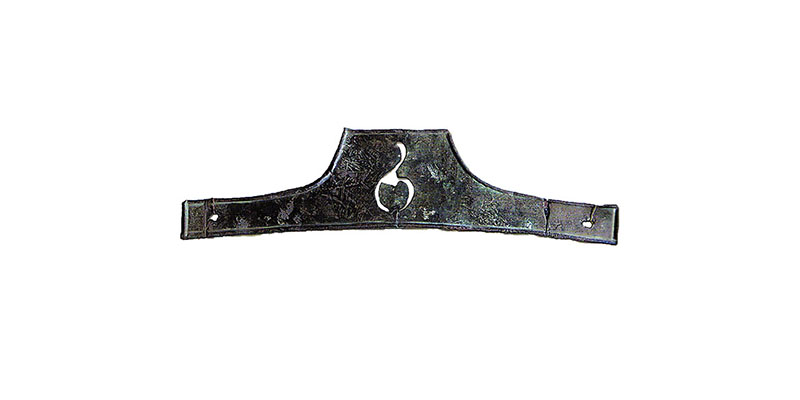
Shako badge regiment Portuguese Legion.
The sign is made of brass by die. In the middle is the letter "Samech" of the Roman alphabet. it means ukvu "P", - "PORTUGAL".
The letter could be broken through-stamped or embossed image immediately familiar with. At the edge of the sign is the rim around the perimeter. At the ends of the sign are holes for fixing to quiver and they also attached submental scales together shako sockets.
Metall Brass
Size 300 mm * 70 mm