


In addition to the regiments of the line infantry and the Guard Grenadiers, the cavalry and artillery of the Kingdom of the Netherlands joined the French army.
So the 3rd Hussars and Horseguards Regiment were united and then they formed the second light cavalry lanciers Guard Regiment.
On the basis of the Second Holland cuirassier regiment there was formed the 14th Cuirassiers Regiment.
The 11th Hussars Regiment of the French light cavalry was formed of the 2nd Hussars of Holland.
Artillery of the Kingdom of the Netherlands consisted of 4 walking artillery battalions and the 1st company of horse artillery.
The hiking artillery of the Kingdom was united in one regiment and was awarded with the number 9 by the taxonomy of the French regiments of the walking artillery. The first horse artillery regiment was given to the horse artillery of the Empire.
The 14th Battalion convoy was 14 artillery battalion convoy of the French army.

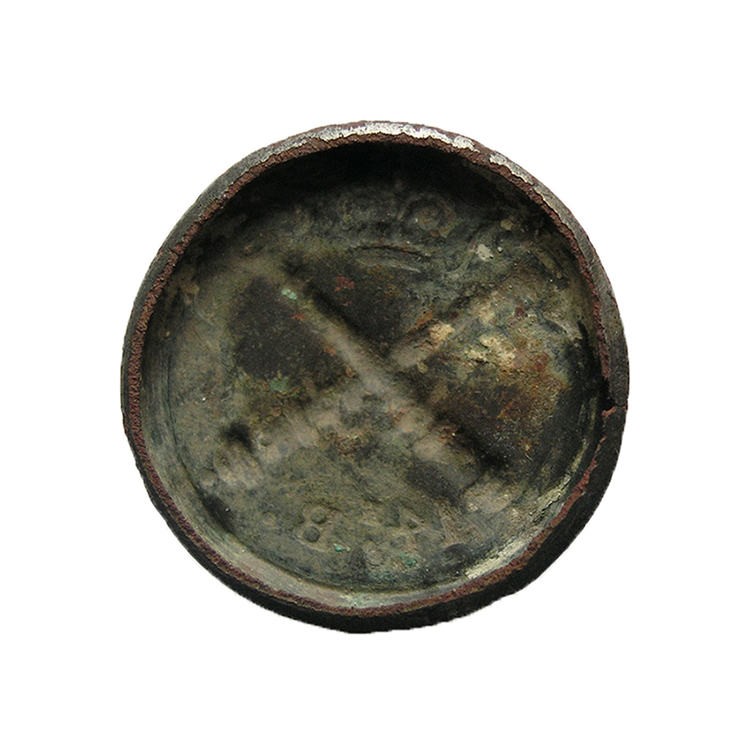
Artillery Dutch kingdom
Large and small buttons artillery Dutch army.
Buttons are made by stamping on a brass plate with subsequent rolling on a wooden base. Loop for attachment to his uniform was made of steel wire. On the field depicts two crossed cannons under the crown, located on a circle ornament or two stylized laurel branches. There are different kinds of drawings on the buttons of this type. Brass plate with pattern was gilded.
Buttons artillery officers of the army of the Dutch kingdom there are not very rare, so the rarity scale from 0 to 5, I think you can put R 3. This specimen was found near the town of Borisov. Do not forget that the buttons larger diameter were much less on the uniform and then they are less likely. Officers buttons are found only in single copies and to assess their rarity can only theoretically.


Mariners of the Dutch kingdom.
Small button seaman Dutch army.
Button made by stamping on a brass plate with subsequent rolling on a
wooden base. On the field is depicted anchor with horizontal stripes.
This button was found at the bivouac among a large number of other
buttons and different things soldiers of the Great Army. Also there came
across a lot of sea buttons and buttons working fleet. The style of
manufacture, size and arrangement of parts of the buttons can only
assume this instance belonging to the Dutch fleet. Brass plate with
pattern was gilded.
Rarity impossible to determine because this button is not 100% determination.


11th (Dutch) company of the 2nd Battalion of the pontoon
Button 11th (Dutch) Company, 2nd Battalion, pontoon.
Buttons are made by molding in a metal mold. On the obverse is
depicted in the center of the anchor. Anchor superimposed on crossed
shovel and hammer. On each side of the letter "O" and "M". The circle is
dotted stroke. Eyelet to his uniform in the form of loops.
After the merger of the Dutch army during the French in 1810, the
company moved into the 11 second pontoon battalion of the French army.
It consists of the Dutch took part in the Russian Campaign.
There are only isolated finds of buttons. Rarity can be defined as R4.


Large button artillery Dutch army.
Buttons are made by stamping on a brass plate with subsequent rolling on a wooden base. Loop for attachment to his uniform was made of steel wire. On the field depicts two crossed cannons under the crown, located on a circle ornament or two stylized laurel branches. There are different kinds of drawings on the buttons of this type. Brass plate with pattern was gilded.
Buttons artillery officers of the army of the Dutch kingdom there are not very rare, so the rarity scale from 0 to 5, I think you can put R 3. This specimen was found near the town of Borisov. Do not forget that the buttons larger diameter were much less on the uniform and then they are less likely. Officers buttons are found only in single copies and to assess their rarity can only theoretically.
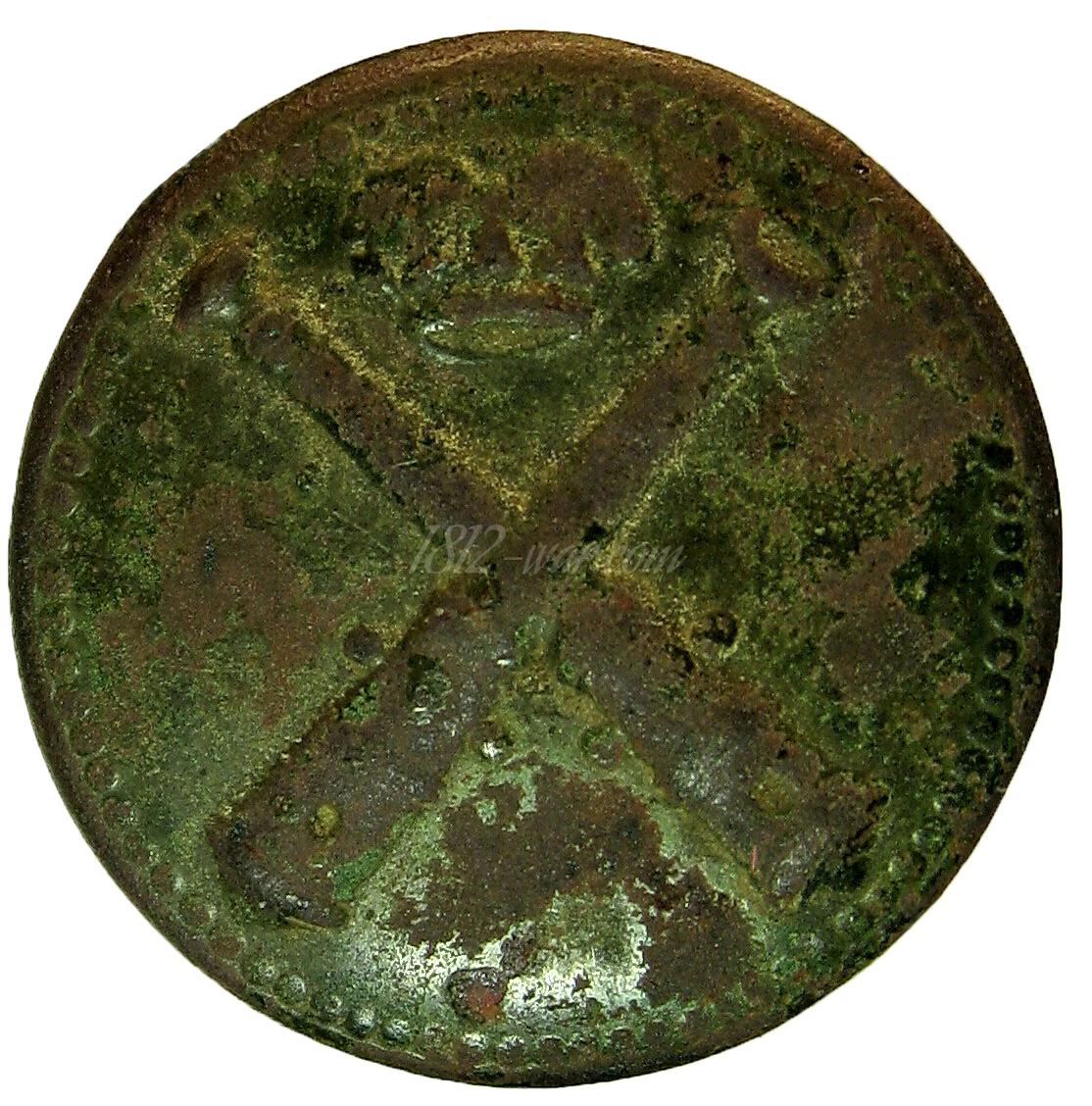

Large button artillery Dutch army.
Buttons are made by stamping on a brass plate with subsequent rolling on a wooden base. Loop for attachment to his uniform was made of steel wire. On the field depicts two crossed cannons under the crown, located on a circle ornament or two stylized laurel branches. There are different kinds of drawings on the buttons of this type. Brass plate with pattern was gilded.
Buttons artillery officers of the army of the Dutch kingdom there are not very rare, so the rarity scale from 0 to 5, I think you can put R 3. This specimen was found near the town of Borisov. Do not forget that the buttons larger diameter were much less on the uniform and then they are less likely. Officers buttons are found only in single copies and to assess their rarity can only theoretically.


Small button artillery Dutch army.
Buttons are made by stamping on a brass plate with subsequent rolling on a wooden base. Loop for attachment to his uniform was made of steel wire. On the field depicts two crossed cannons under the crown, located on a circle ornament or two stylized laurel branches. There are different kinds of drawings on the buttons of this type. Brass plate with pattern was gilded.
Buttons artillery officers of the army of the Dutch kingdom there are not very rare, so the rarity scale from 0 to 5, I think you can put R 3. This specimen was found near the town of Borisov. Do not forget that the buttons larger diameter were much less on the uniform and then they are less likely. Officers buttons are found only in single copies and to assess their rarity can only theoretically.


Small button artillery Dutch army.
Buttons are made by stamping on a brass plate with subsequent rolling on a wooden base. Loop for attachment to his uniform was made of steel wire. On the field depicts two crossed cannons under the crown, located on a circle ornament or two stylized laurel branches. There are different kinds of drawings on the buttons of this type. Brass plate with pattern was gilded.
Buttons artillery officers of the army of the Dutch kingdom there are not very rare, so the rarity scale from 0 to 5, I think you can put R 3. This specimen was found near the town of Borisov. Do not forget that the buttons larger diameter were much less on the uniform and then they are less likely. Officers buttons are found only in single copies and to assess their rarity can only theoretically.


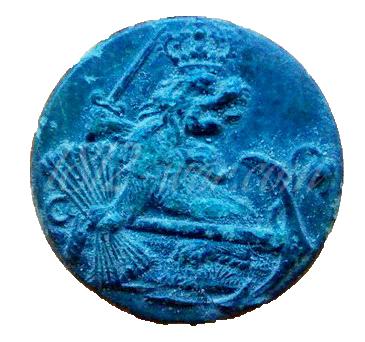
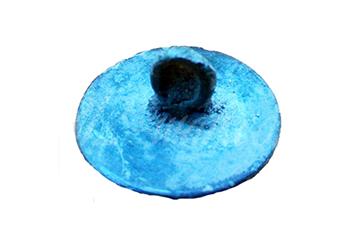
Small button naval officer of the Dutch kingdom .
Button made by stamping on a brass plate, followed by rolling on a
wooden base. On the field, it depicts a lion holding an anchor. This
button was found on the bivouac among a large number of buttons, and
other various things the soldiers of the Grande Armée in Borisov area.
Brass plate with a pattern was gilded.
There are only isolated finds of buttons. Rarity can be defined as R5.
There are no reviews for this product.
No questions about this product.
-220x201.JPG "Button 1 Cuirassiers Regiment. France.")

