


In October 1809 , after the victory over the French army, Austria, between the two countries signed a peace treaty Schönbrunn , under which France ceded to the Austrian part of the land . In particular, it moved to the area are part of modern Croatia and Slovenia.
A 15 April 1811 the newly acquired land de jure become a full-fledged French territory and the population was ordered to comply with the Code Napoleon.
However, the relative distance from the metropolis and historically close ties with Austria these areas , slowed the assimilation of new lands.
Until March 1811 the governor of the Illyrian Provinces was Marshal Marmont . On his advice was kept six regiments District "Military of Croatia." Here they are:
1st Regiment Lichansky
2nd Regiment Ottochansky
3rd Regiment Ogulinsky
4th Regiment Sluinsky
5th Regiment Banat
6th Regiment Banat
Before going to Russia , according to the decree of the Emperor of September 21, 1811 , from 2 granicharnyh regiments ( 1st Lichanskogo and 2nd Ottochanskogo ) was formed on 1 st temporary Croatian regiment . This regiment was organized the second in a row, but he got the first number because the serial numbers of regiments of which it was formed : the 1st and 2nd .
The first review Regiment Emperor was held in Paris on 8 December 1811 . After that, Napoleon signed a decree granting the regiment new uniforms and all equipment .
In the Russian Campaign attended the 1st and 2nd battalions of the regiment.
At this time in the ranks was 45 officers and 1,462 lower rank.
Commanded a regiment came from a noble family of Croatian Colonel Marco de Slivarich Heldenburg .
First temporary Croatian regiment was assigned and participated in the campaign as part of the 1st Brigade 13th Infantry Division , commanded by Major-General Joseph Baron Alexis Delzon . Division in turn was part of the Fourth Army Corps of the Italian viceroy Eugene de Beauharnais .
In the first battle in Russia have Ostrovno regiment showed his best side . Six representatives of the regiment for valor from the hands of the Emperor received the Legion of Honor . But the regiment paid a heavy price for his bravery . Failure retired eight officers and about 350 soldiers .
In Smolensk regiment entered August 23, 1812 as part of 32 officers and 994 enlisted men .
Borodino soldiers and officers of the regiment again earned 6 Legion of Honor . Loss regiment made a small amount of the lower ranks. As a result , after the regiment came to Moscow in his list includes 34 officers and 897 enlisted men .
First temporary Croatian Regiment also distinguished in the battle for Maloyaroslavetz . Here losses were greater - 12 officers and about 250 privates.
Under the red in the fourth body after unsuccessful attempts to break the orders of Russian troops regiment lost 14 guns and baggage. Failure dropped 4 officers and 80 enlisted men .
During the crossing of the Grand Army of the Berezina regiment covered the retreat of the remaining troops. In this battle the Croats lost three officers and 90 men of the lower ranks .
Despite the enormous losses and disruption of almost the whole army , the regiment left the borders of the Russian Empire is quite organized.
In 1813, the First Interim Croatian regiment was disbanded .
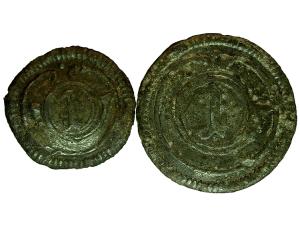
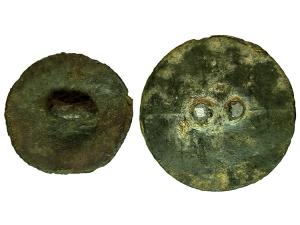
1st temporary Croatian Regiment
Large and small buttons First interim Croatian regiment of the French army . Buttons made by casting into a metal mold . Drawing on the button shows two laurel branches - a symbol of victory and glory , which honored the Roman legionaries .
Besides the figure "1 " is written in a style that is characteristic of the Austrian coins and areas bordering with Austria. The figure is in Jaeger horn as Croatian light infantry regiments were considered .
Regimental buttons with a unique writing "1" the rare , so the rarity scale from 0 to 5 , I think you can give them rank R 3 .
In any case, the buttons are made of tin are almost always caught with broken edges or crumble in your hands. Large buttons having a greater mass and volume of metal destroyed less intensively than small though to get a button in good condition , too much luck .
This happens because the so-called " tin pest ." Because of this tin buttons and other parts of the ammunition made of tin just falling apart , becoming completely inaccessible to historians and collectors.
Officers buttons are found only in single copies and evaluate their rarity can only be estimated .


Button made by molding in a metal mold. Drawing on the button
symbolizes the two laurel branches, which honored the Roman legionaries,
as a symbol of victory and glory. In addition, the number 1 is written
in a style that is characteristic of the Austrian coins and areas
bordering Austria. The figure is in the ranger pipe, as light infantry
regiments were considered.
Large buttons with regimental number with a kind of writing numbers 1
rare, so the rarity scale from 0 to 5, I think you can put R 4. In any
case, the buttons are made of tin almost always come across with broken
edges or fall apart in your hands. Large buttons having greater mass and
volume of metal destroyed less small, but to get such a button in a
good condition also a great success. This happens because the so-called
"tin pest." In this case, tin buttons and other parts of the ammunition
made of tin simply fall apart completely unavailable to historians and
collectors. Officers buttons are found only in single copies and to
assess their rarity can only theoretically.


Button made by molding in a metal mold. Drawing on the button
symbolizes the two laurel branches, which honored the Roman legionaries,
as a symbol of victory and glory. In addition, the number 1 is written
in a style that is characteristic of the Austrian coins and areas
bordering Austria. The figure is in the ranger pipe, as light infantry
regiments were considered.
Large buttons with regimental number with a kind of writing numbers 1
rare, so the rarity scale from 0 to 5, I think you can put R 4. In any
case, the buttons are made of tin almost always come across with broken
edges or fall apart in your hands. Large buttons having greater mass and
volume of metal destroyed less small, but to get such a button in a
good condition also a great success. This happens because the so-called
"tin pest." In this case, tin buttons and other parts of the ammunition
made of tin simply fall apart completely unavailable to historians and
collectors. Officers buttons are found only in single copies and to
assess their rarity can only theoretically.
There are no reviews for this product.
No questions about this product.