
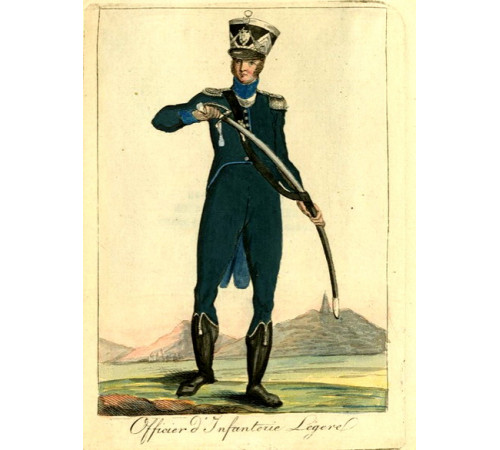
The Kingdom of Westphalia. The 4th battalion of the light infantry.
The Kingdom of Westphalia was established after the signing of the Tilsit Treaty. It was formed by combining three areas into one state. It includes lands of Prussia, part of Berg, Munster and East Frisia.
Because of the fact that only a part of the territory of these areas was included into the new Kingdom there was added Hesse-Kassel, Braunschweig and Hanover.
By the Decree of November 15, 1807 Napoleon secured the throne for his younger brother Jerome Bonaparte. The capital of the new state was the city of Kassel.
The army of the Kingdom of Westphalia was created as a model for other German states. It was created by the French system, but the officer corps was drawn from former officers of the United States. The basis of the army consisted of Hessians, but in the top positions there were French officers. Not all of the officers of the attached lands went into the army of the new state. A significant part of the officer corps of the army of Hanover went to the UK and joined the established there King's German Legion.
The basis of the model army was the disbanded part of Hessen-Kassel, the Germans of not the Prussian origin, who were captured by the French in 1806. But a large part of the army was complete on account of conscripts and volunteers.
By 1812, for the Russian campaign there was formed a Corps with well equipped and trained soldiers. The King Jerome Bonaparte became the commander of the 8th (Westphalian) Army Corps.
But he did not have the leadership talent of his brother so Major-General of the French service Dominique Joseph R. Vandam helped the King in fact to command the corps.
The third light battalion was formed from volunteers and conscripts of the newly united land. To 1812 the regiment consisted of 970 people. There was one drill battalion and one spare company. In its turn, the marching battalion consisted of 1 Carabineers’, 1 Voltigeurs’ and 4 jagers’ companies with 139 people in each. A spare company was consisted of 139 people.
It is still unknown about the participation of the battalion in the campaign of 1812.
In 1813, the battalion took part in the Battle of Leipzig, on October 16, 1813 - October 19, 1813.
After Napoleon's defeat the remnants of the army were disbanded and returned to civilian life.

There are no reviews for this product.
No questions about this product.