

The Kingdom of Westphalia was established after the signing of the Tilsit Treaty. It was formed by combining three areas into one state. It includes lands of Prussia, part of Berg, Munster and East Frisia. Because of the fact that only a part of the territory of these areas was included into the new Kingdom there was added Hesse-Kassel, Braunschweig and Hanover.
By the Decree of November 15, 1807 Napoleon secured the throne for his younger brother Jerome Bonaparte. The capital of the new state was the city of Kassel.
The army of the Kingdom of Westphalia was created as a model for other German states. It was created by the French system, but the officer corps was drawn from former officers of the United States.
The basis of the army consisted of Hessians, but in the top positions there were French officers. Not all of the officers of the attached lands went into the army of the new state.
A significant part of the officer corps of the army of Hanover went to the UK and joined the established there King's German Legion.
The basis of the model army was the disbanded part of Hessen-Kassel, the Germans of not the Prussian origin, who were captured by the French in 1806. But a large part of the army was complete on account of conscripts and volunteers.
By 1812, for the Russian campaign there was formed a Corps with well equipped and trained soldiers. The King Jerome Bonaparte became the commander of the 8th (Westphalian) Army Corps.
But he did not have the leadership talent of his brother so Major-General of the French service Dominique Joseph R. Vandam helped the King in fact to command the corps.
The second light battalion was formed from volunteers and conscripts of the newly united land. To 1812 the regiment consisted of 970 people. There was one drill battalion and one spare company. In its turn, the marching battalion consisted of 1 Carabineers’, 1 Voltigeurs’ and 4 jagers’ companies with 139 people in each. A spare company was consisted of 139 people.
The regiment was in the 23rd Infantry Division of Major-General Baron Jean Victor Toro that was a part of the 2nd Brigade under the command of Brigadier General J. B. I. Tsurvesten and Count von Vikselberga.
On June 25, 1812 the 2nd light infantry battalion exposed 23 officers and 737 established men under the command of a battalion chief Johann L. Bёdikera to the Russian campaign.
The battalion fought at Valutina Mountain on August 19, 1812, at Borodino on September 7, on the Berezina on November 26-28.
In the campaign of 1813 the battalion participated in the Battle of Katzbach on August 26, 1813 and on the blockade of Dresden on October 13- March 14, 1814.
After Napoleon's defeat remnants of the army were disbanded and returned to civilian life.
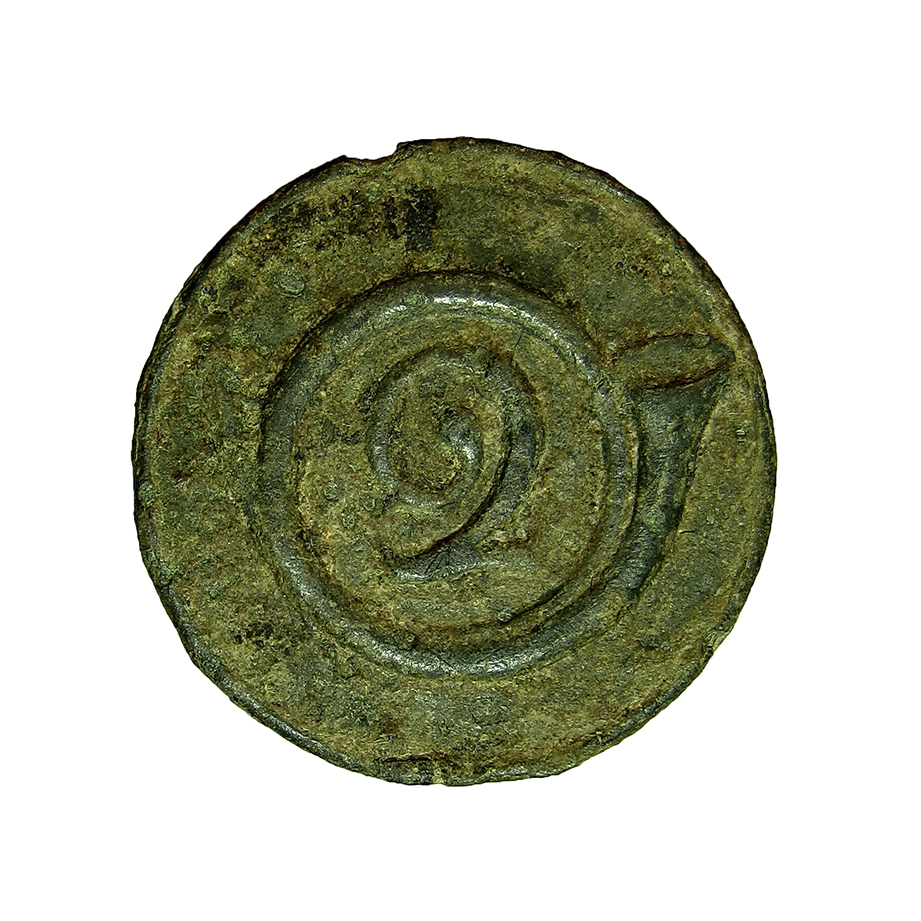
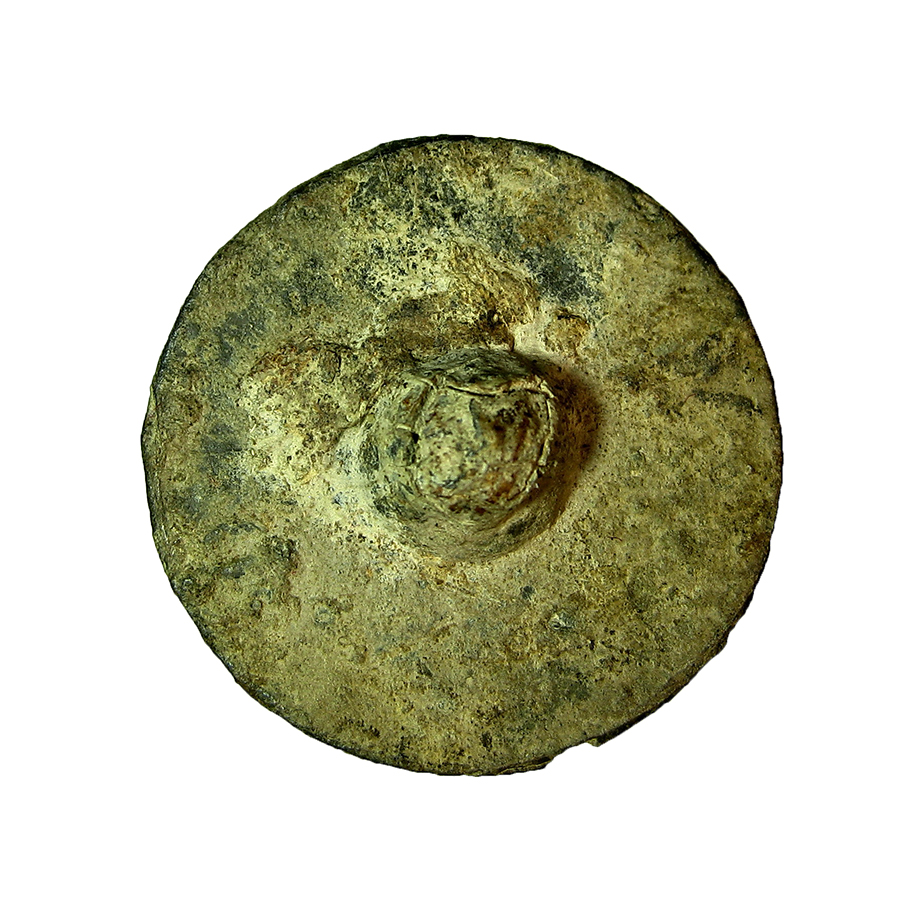
The big button of the 2nd Light Battalion of the Westphalian army.
The buttons are made by molding in a metal mold. The picture on the buttons depicts a jager’s horn as a symbol of the light infantry. The figure in the center represents the number of the battalion, which belonged to the soldiers.
The regimental buttons with the number "2" in jager’s horn are not in common, so their rarity can be evaluate as R 4 by the scale of rarity from 0 to 5.
This type of buttons differs from the French model not by manufacture, but by the type of the button. For the Kingdom of Westphalia the differences of the buttons include a large size and a method of attachment of the metal "eye" to a uniform.
The rim around the edge of the buttons is also a characteristic of buttons that were made for the Westphalian army.
The buttons of smaller diameter are almost never found. It is likely due to the great exposure to the destruction of the time and temperature difference. It is the so-called "tin plague".
In this case, tin buttons and other parts of the ammunition that were made of tin simply crumble and turn to dust.
The officers’ buttons are found only in single copies and we can assess their rarity only approximately.

There are no reviews for this product.
No questions about this product.