
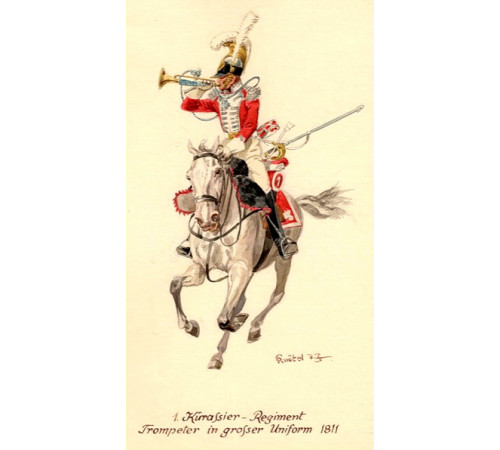
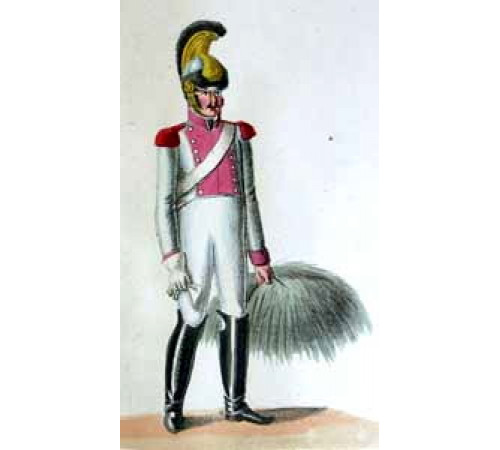
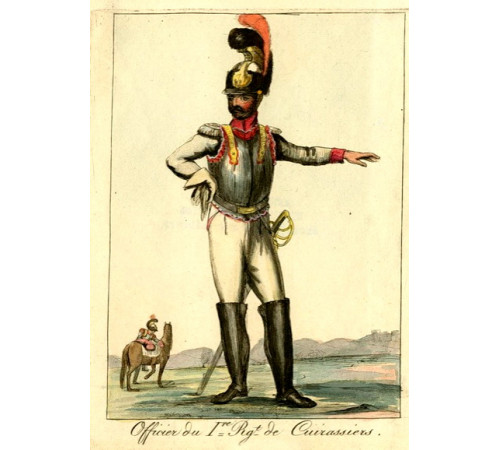
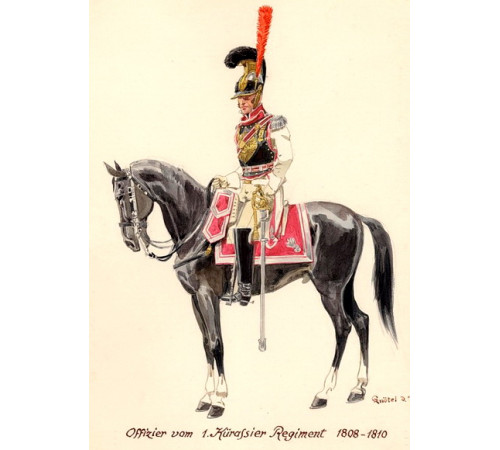


Kingdom of Westphalia was formed after the signing the Treaties of Tilsit. It was proclaimed with the decree of November 15, 1805. The youngest brother of Napoleon - Jerome Napoleon became the King.
The new state was conceived as a standard in all its forms, both military and governmental. It was supposed to be a model for other German states. The Emperor insisted on holding liberal and radical reforms in the young state. However, the young King Jerome had not shown himself as a capable monarch, so all taken actions did not give the desired result.
The army of a new state began to form from scratch. It didn’t have longstanding traditions, army officers was a mixture of the different armies of the German states, mostly Hesse - Kassel, Prussia and Hanover. However, most of the Hanoverian officers fled to the UK.
The young king was more concerned about the appearance of troops than about the need to prepare for future battles.
It was hard for small state to form and contain heavy cavalry regiments, particularly, two cuirassier regiments. But they contributed to the capture of famous Kurgan height in the Battle in Borodino.
Undoubtedly the most brilliant and costly cavalry units of the Grand Army were two regiments of cuirassiers of the Kingdom of Westphalia.
In 1812, there were the regiments consisted of 4 squadrons, each squadron had 2 companies. Apart from companies of the squadron, 1 replacement company was formed. Each regiment consisted of 735 people. Each combat squadron was formed by 158 people, and the spare company included 79 people.
To the Russian campaign regiments came almost at full composition. It is interesting that even though these regiments were called Kirasirsky, they didn’t wear cuirasses before 1810.
By June 30, 1812 1st Westphalian cuirassier regiment had in his composition the 1st, the 2nd,the 3rd and the 4th squadrons of the total number of 34 officers and 504 people of lower rank. The regiment was commanded by Colonel Baron Georg LA von Gilza.
Cuirassier regiments were the 2nd Brigade of Brigadier General Helmut A. Lepel, which belonged to the 7th Division of heavy cavalry of Major-General Baron Jean T. Lorzha of the fourth Cavalry of Cavalry Corps.
Westphalian army in relation to the French was much worse supplied with food and fodder. Despite this fact, cavalry of the 1st cuirassier regiment took part in one of the most important and bloody battles - Borodino being almost in full composition. By 4 th of September losses in the regiment were 63 people.
On the morning of September the 7th regiment lined up on the field of Borodino. After standing under artillery and rifle fire up to eleven hours, brigade commander, Brigadier-General Helmut A. Lepel and the regimental commander, Colonel von Gilza were fatally injured.
For the entire day of the battle 4 officers were killed and 16 were wounded in 2 regiments. The number of incapacitated lower ranks was much bigger.
After the Battle of Borodino personnel of the First Regiment was granted by the Emperor with 6 crosses of the Legion of Honor.
Besides, cuirassiers of the 1st Regiment of the Kingdom of Westphalia took part in the Battle of Berezina River.
They along with the rest of the soldiers, loyal to their military duty, were blocking the crossing. Only thanks to the heroism of these soldiers, thousands of French and other soldiers and civilians, disorganized and lost human look, were able to reach other side of the river. But not everybody managed to escape from a terrible fate to die on the way home.
There are no reviews for this product.
No questions about this product.