The Kingdom of Westphalia was formed after the Tilsit Treaty. It proclaimed the decree of November 15, 1805. The younger brother of Napoleon Jerome Napoleon became the King.
The new state was conceived as a standard in all its forms, as well as military and governmental. It was supposed to be a model for other German states. The Emperor insisted on holding liberal and radical reforms in the young state. However, the young King Jerome had not shown himself as a capable monarch, so all actions that had been taken did not give the desired result.
The army of the new state began to form from scratch. There were not any long traditions; the officers were a composition of different armies of the German states, mostly of Hessen- Kassel, Prussia and Hanover. However, most of the Hanoverian officers fled to the UK.
The young King was more concerned about the appearance of troops than the need to prepare them for future battles.
It was hard for the small state to form and contain heavy cavalry regiments, particularly, two cuirassier regiment. But they contributed the capture in the famous Borodino Battle at the Kurgan height.
The Hussars regiments of Westphalia repeated the similar units of the French army. The Hussars received the uniform of the French model. In the 2nd Regiment the shakos had blue and white plumes cords. The dolmans were blue with red cuffs and collar, blue mentik and blue chikchiri.
By 1812 the regiment was designated as the regiment of 4 squadron composition. The composition of each squadron consisted of two companies, four squadrons and 1 Replacement Company.
All the personnel of the regiment included 734 people. Each marching squadron consisted of 158 soldiers and officers, and in the company of their reserve there were 79 people.
The regiments came almost at full strength to the Russian campaign.
On June 25, 1812 the 1st Westphalian hussars regiment included the 1st, the 2nd, the 3rd and the 4th squadrons with the total number of 39 officers and 5859 established men. The regiment was under the command of Colonel Baron Karl K. Hessberg.
The Hussars were in the 24th Light Horse Brigade that was under the command of Brigadier General Count Hans G. von Hammerstein-Ekuorda, of the Eighth Cavalry Army Corps that was commanded by Brigadier General Pierre Chabert.
The Westphalian army was worse supplied with food and fodder in comparison with the French. It caused a great loss of personnel of marching division.
However, the hussars with the rest of the troops of the 8th Corps took part in the battles of Mount Valutina on August 19, 1812, of Borodino on September 7, 1812 and the Berezina on November 26-28, 1812.
In the battle on the river Berezina, the hussars, together with other soldiers and officers, loyal to their military duty, were blocking the crossing.
Only thanks to the heroism of these soldiers, thousands of French and other soldiers and civilians, disorganized and lost human look, were able to reach other side of the river.
But not everybody managed to escape from a terrible fate to die on the way home.
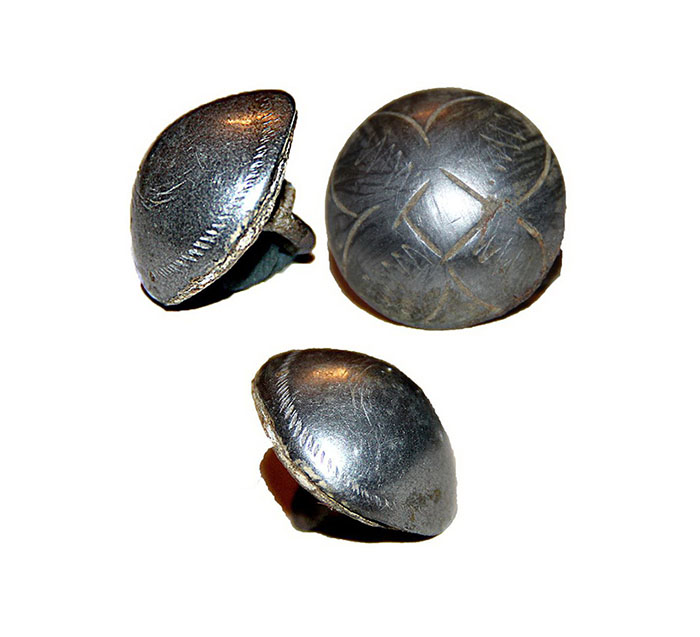
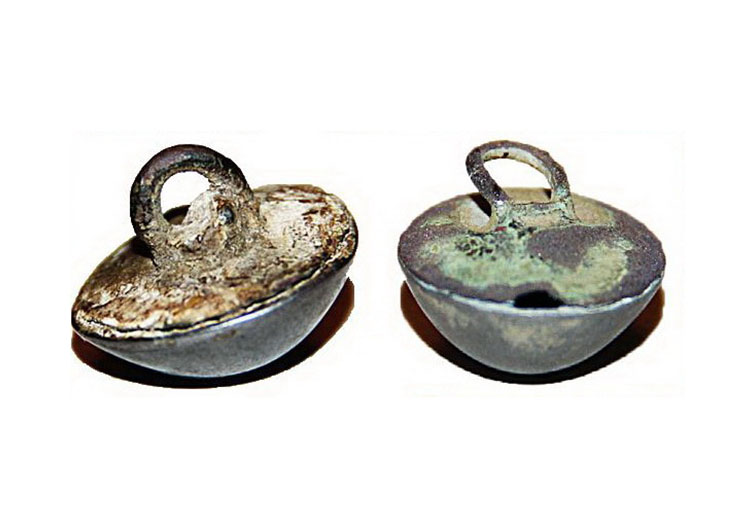
Buttons hussar regiments Kingdom of Westphalia.
Hussar buttons made generally known by the model for this kind of troops. Given the similarity of the hussar uniforms in various armies of the world of that period. On such uniform number buttons reached about 80 pieces. Size of the button could be different. In the center of the larger diameter buttons sewn on the edge of going smaller.
All buttons were in the form of a sphere or hemisphere. Basically, hussar uniforms for the French army is characterized by the buttons in the form of a sphere.
Buttons Westphalian hussars almost all were made in the form of a hemisphere and were made of the same size. A characteristic feature is the production of white metal buttons. Only a small part was made from tin alloy. Another feature is the decoration field buttons with various ornaments.
Manufacturing method of soldering buttons produced the top of the hemisphere to the brass base with a steel or brass eyelet. There were options with a hemisphere of white metal and filled tin alloy steel ear.
Buttons 1 - and 2 - th regiments did not differ among themselves.
Presented buttons were found on the front line outposts Westphalian hussars under Mozhaisk. These buttons are found at the crossing of the Berezina and further along the road of retreat to Vilna.
According to the rarity of R 3 can be put.


Hussar buttons made generally known by the model for this kind of troops. Given the similarity of the hussar uniforms in various armies of the world of that period. On such uniform number buttons reached about 80 pieces. Size of the button could be different. In the center of the larger diameter buttons sewn on the edge of going smaller.
All buttons were in the form of a sphere or hemisphere. Basically, hussar uniforms for the French army is characterized by the buttons in the form of a sphere.
Buttons Westphalian hussars almost all were made in the form of a hemisphere and were made of the same size. A characteristic feature is the production of white metal buttons. Only a small part was made from tin alloy. Another feature is the decoration field buttons with various ornaments.
Manufacturing method of soldering buttons produced the top of the hemisphere to the brass base with a steel or brass eyelet. There were options with a hemisphere of white metal and filled tin alloy steel ear.
Buttons 1 - and 2 - th regiments did not differ among themselves.
Presented buttons were found on the front line outposts Westphalian hussars under Mozhaisk. These buttons are found at the crossing of the Berezina and further along the road of retreat to Vilna.
According to the rarity of R 3 can be put.


There are no reviews for this product.
No questions about this product.